I have five LilyGO T-Beam SUPREMEs all transmitting and receiving every 15 seconds via Lora radio (Semtech 1302 chip). This is a test of mutliple units being active and then seeing how well a Lora sniffer works. The units are named:
- Amy
- Bob
- Cy
- Dan
- Ed
I also have a Lora sniffer using the Semtech 1303 chip on a separate Raspberry Pi server which can capture up to 8 simultaneous transmissions. Then I have a logger which preserves what the sniffer found. And then I have an awk script which traverses the log and determine where there are gaps in transmission, i.e. lost packets, collisions.
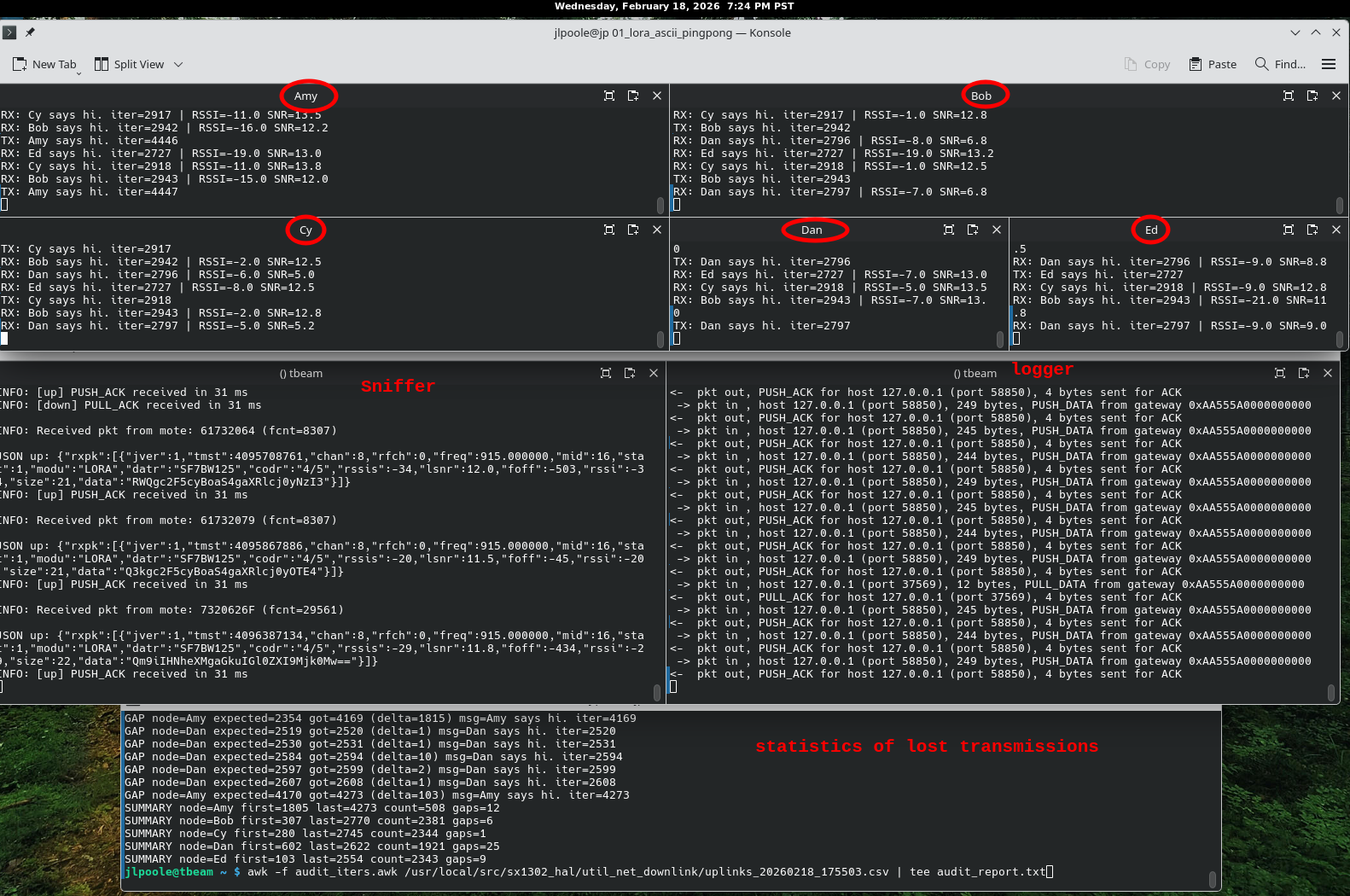
I’ve been focusing on foundational issues: getting the SD card to be reliable so it can be used like a hard disk is on a computer, synchronizing GPS time with the unit’s real time clock and coordinate everyone’s time to extremely high precision. The SD card component is very delicate, it seems if I start a component up, the voltage jitter enough to cause the SD card to go into a hung state which is only cured by removing the card and an inserting it again. This is not acceptable. I thought I had the problem cured, and then proceeded onto the GPS time “discipline” and it seems that activating the GPS may have triggered some power issues that are affecting the SD card… again. I’m starting to feel the pain of working on a 2012 Intel platform with a video card no longer supported by NVidia — i could not get OBS to record a screenshot video of all the 8 consoles above, so we have to settle for a static screenshot.
Progress is being made, albeit it very slowly.
Update 2/19/26 9:30 AM – I have added a naming scheme so when I plug in a device, it’s name is used so it is very clear what device I am loading code into. See USB Naming.
Leave a Reply