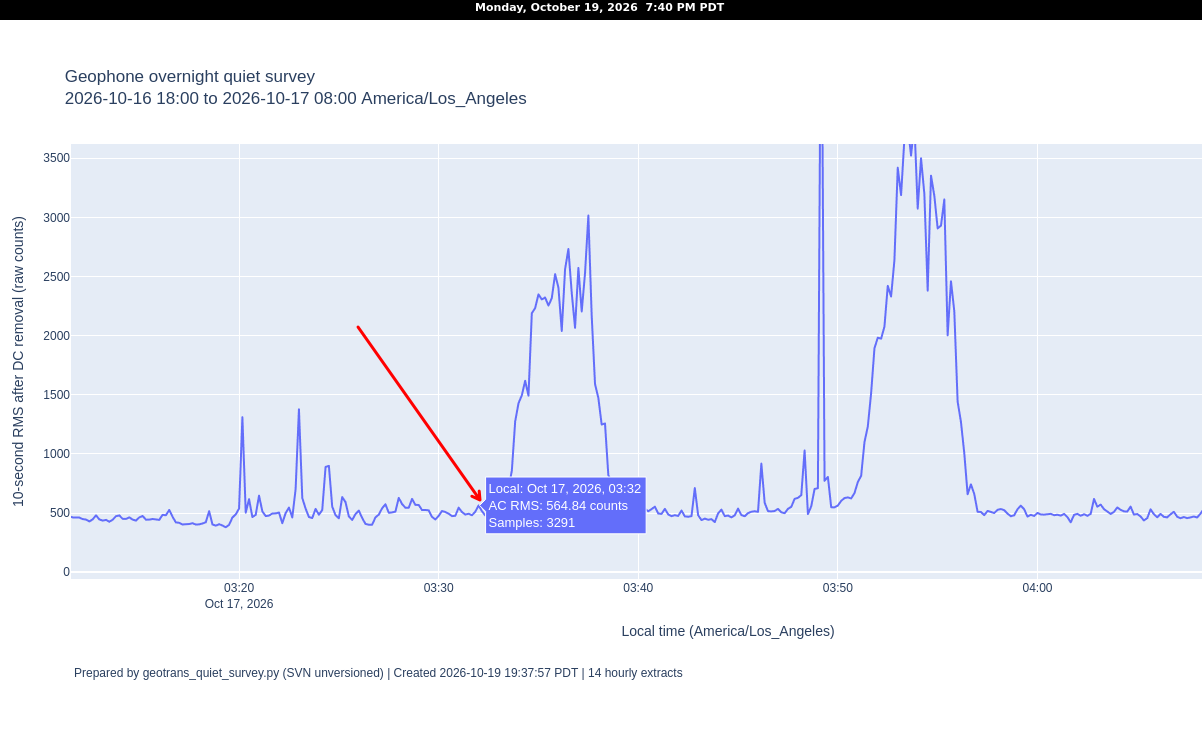
This post continues my previous post “My 1″ Geophone Tracked A Mighty Freight Train.” There we learned that a small geophone can measure seismic waves, i.e. ground waves, and that when a freight train comes by, there is a substantial increase of low frequency waves. The question then became: what frequencies, and by how much.
Today, I’ve determined what the frequencies measured are and then compared them to a base line taken when no trains were presumbly around. I call the baseline the “10 minute Salem quiet baseline.” What i did was survey a night from 7:00 pm to 8:00 am the following morning and ask: what 10 minute period of time had the least amount of activity. My scripts determined that the quietest 10 minute time segment is:
Monday 1:34 AM to 1:44 AM (2026-10-19 01:34:20 to 2026-10-19 01:44:20)
I then compared my “10 minute Salem quiet [quietest] baseline” with the Saturday confirmed freight train activity captured during at 3:34 AM.
Here’s my result (see interactive plot at https://salemdata.net/HDC/dev/geophone/train_vs_quiet_10min_20261020_grid.html):
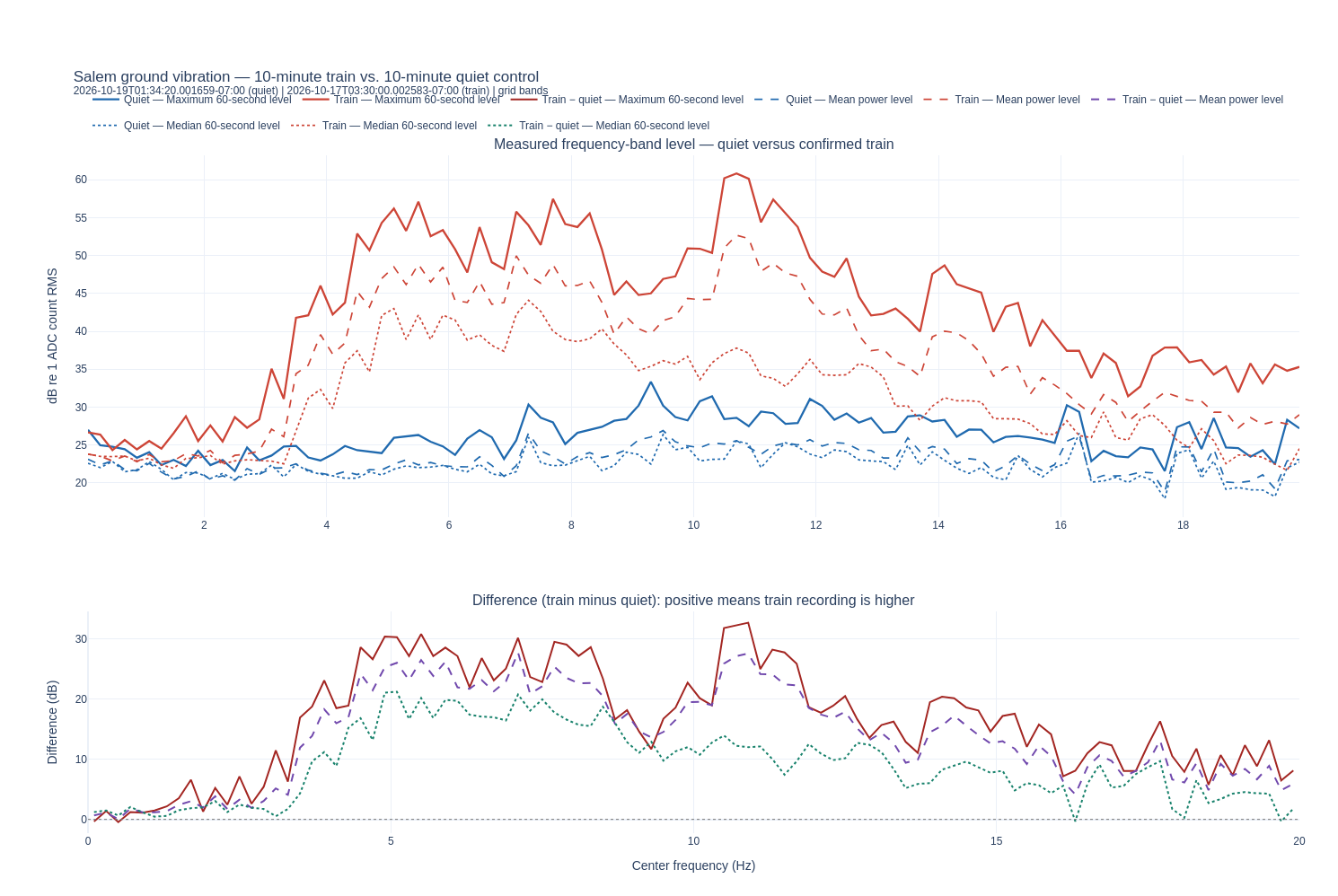
Three findings stand out:
-
10.933 Hz: Maximum increased by 32.68 dB.
-
10.667 Hz: Maximum increased by 32.49 dB.
- 6.067 Hz: Median increased by 20.56 dB.
I’m convinced now that my geophone is, indeed, capturing seismic waves and that infrasound waves can appear much stronger when freight trains pass by. Therefore, This gives me considerable confidence that the geophone system is reliably detecting train-generated ground vibration and is ready for field testing near hyperscale data centers.
Leave a Reply