Category: Uncategorized
-

Train Tracker
<p>Once again, I am in need of knowing when trains travel nearby at the crossing of Court ST and other crossings nearby. This time is to confirm my readings from a pressure transducer (really just like a microphone but gives out voltages) on the assumption that freight trains emit infrasounds through the air. I’ve already…
-
Local AI: PDF Digestion
<h1>Introduction</h1> <p>My local AI, the <a href="https://github.com/Niko1221/Strata">Strata</a> project model <strong>qwen3.8-flash-next-iq3_s,</strong> does not accept PDFs for upload.</p> <p>The interface <em>does</em> accept binary images. So if I want my chat to consider the contents of a PDF, I have to extract its text and images and then upload the text and images to my local chat. This…
-
When A Freight Train Passes By, What Sub-20 Hz Ground Vibrations Do I Observe??
This post continues my previous post “My 1″ Geophone Tracked A Mighty Freight Train.” There we learned that a small geophone can measure seismic waves, i.e. ground waves, and that when a freight train comes by, there is a substantial increase of low frequency waves. The question then became: what frequencies, and by how much.…
-
Reticulum 1.3.7 vs. My 1.3.5 Protocol Specification
Since no specification exists for the Reticulum protocol, I previously undertook to derive a specification from the Mark Qvist implementation. See A Reticulum Protocol Specification, Extracted from the Implementation (“Specification”). When I did so several weeks ago, I was working against Reticulum version 1.3.5. In source control parlance, that means the Specification I created is…
-
Reticulum: Finding The Definitive Source
<h1>Where, oh where, is the current Reticulum source of truth?</h1> <p>Currently the Reticulum protocol is accepted as defined within the Python code implementation created by Mark Qvist. There is no formal specification for the Reticulum protocol. Hence the protocol is derived from Mark’s Python source tree. The question I faced: where can I obtain the current…
-
Testing Satellite Time Synchronization Across Seven T-Beams
<p>The LilyGO T-Beam Supreme has a real time clock, aka “RTC”, circuit powered by a small hidden rechargeable battery that can hold a charge for 2-3 days. If your T-Beam is without power from A) its larger battery, a 18650 Li-Ion battery or B) a powered USB connector, then your stored date and time value…
-
Achieving 166 µs Clock Synchronization Across 7 T-Beams
After much effort, I finally achieved running 7 T-Beams for 17 minutes, and having them create internal clocks based on satellite pulse per second, aka “PPS”, and finding they spanned by 166 µs. One hurdle I had to overcome was a physical one: 1) the top of the T-Beam contains the GPS antenna which is…
-
Shaving 8–9 Minutes Off Each Test Cycle
A recent dialog reminded me why having a powerful — and fun — Ryzen 7950-based system is helpful. I’m performing testing of hand-held radio units to see how mesh software, ostensibly Reticulum-based units, perform out in the field. The magic of mesh networks is that it can extend the range limits between two radio units.…
-
Reticulum on Rust: Comparison Of Two Projects
<p><strong><span style="color: #ff0000;">highly technical</span></strong></p> <p>There are two projects that came to my attention where the Reticulum implementation is built using the Rust programming language. I know very little Rust, but I have been impressed with everything so far. Scott Lamb of the <a href="https://github.com/scottlamb/moonfire-nvr">Moonfire NVR</a> project has been suggesting I learn Rust since 2018, and…
-
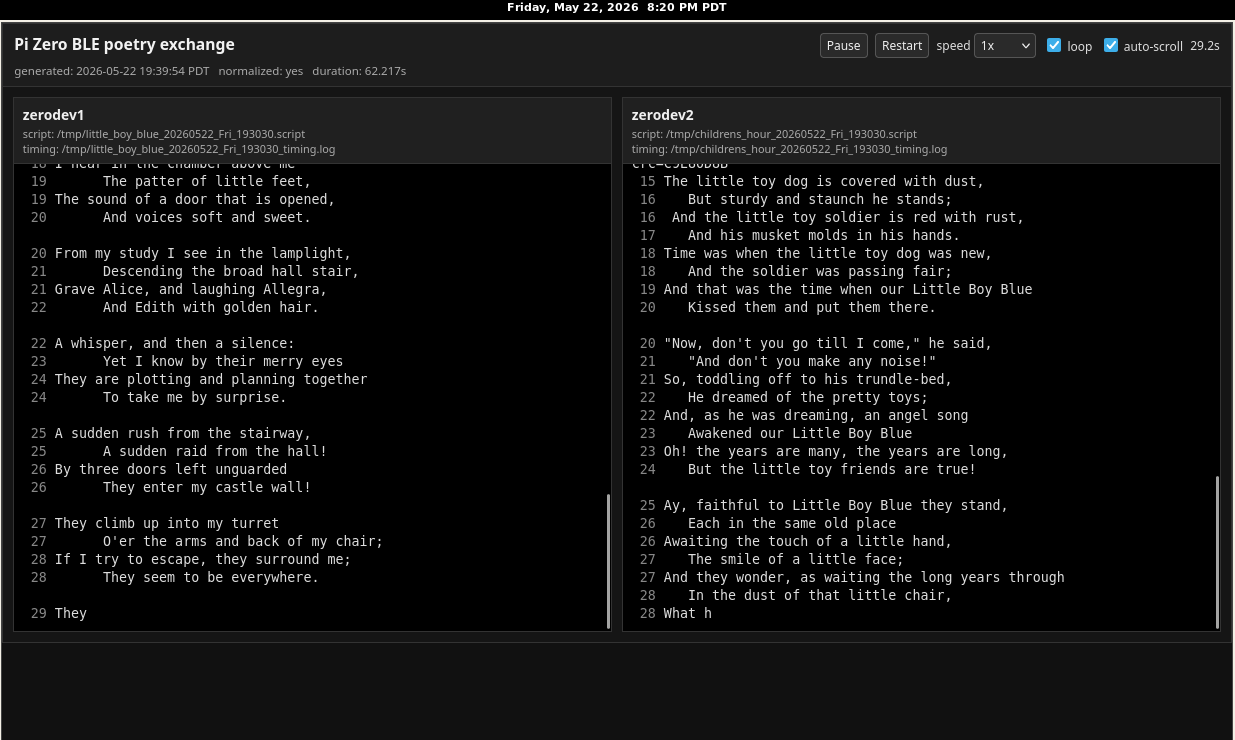
A Better Way to Record Timed Linux Terminal Sessions
<h2>Timed Terminal Captures with <code>script</code>, <code>timeout</code>, and a Future Launch Time</h2> <p>I recently needed to run the same command on two separate Raspberry Pi Zero 2W systems at almost exactly the same time. Both machines were disciplined to the same local stratum-1 time server, so their clocks were already close enough, e.g. less than 1…