Category: Mesh Network
-
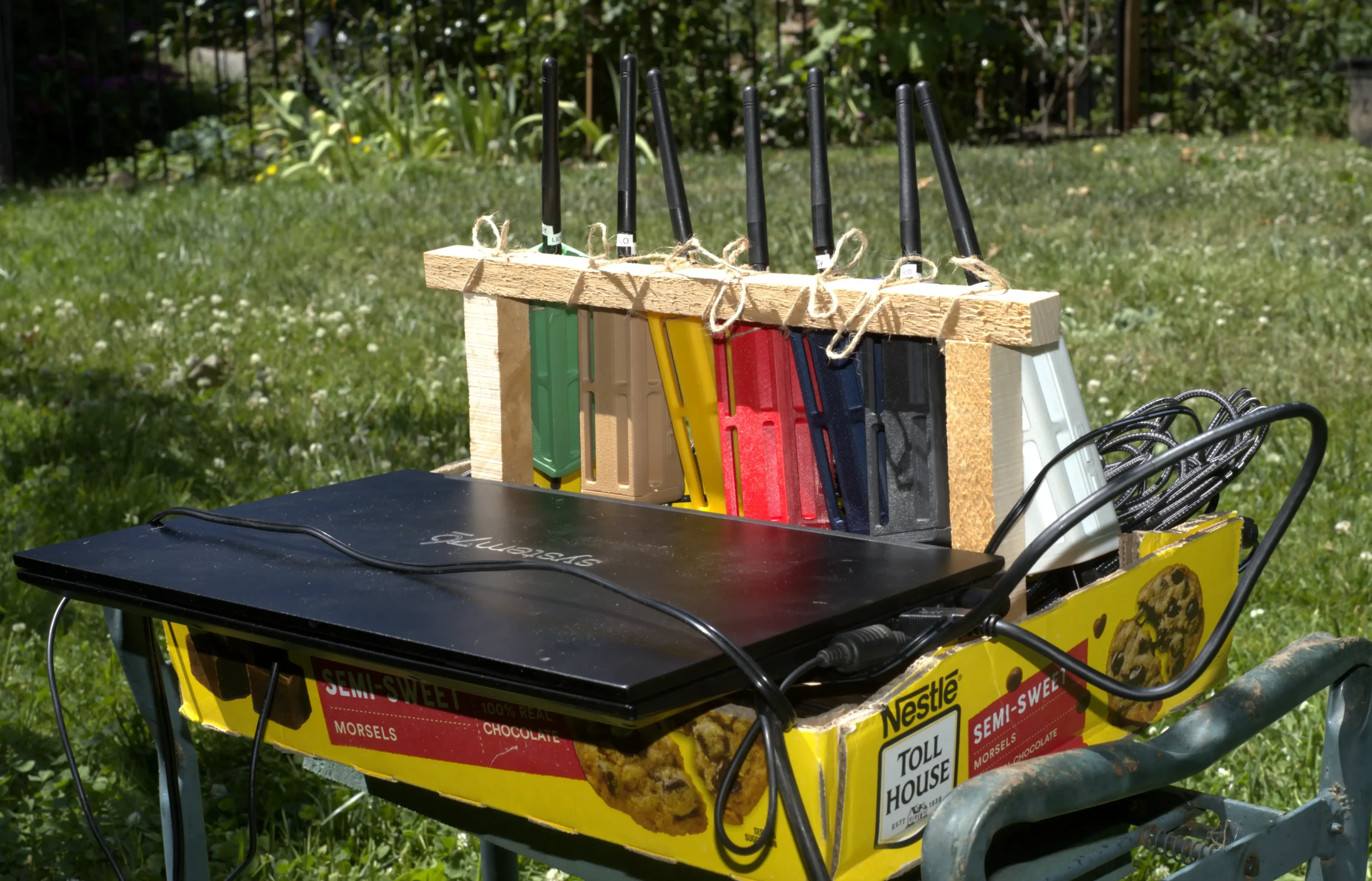
Reticulum: A Precision Trace Among 7 Nodes
What actually happens inside a Reticulum mesh running over LoRa when two endpoints cannot communicate directly? I built a seven-node testbed using LilyGo T-Beam SUPREME units named AMY, BOB, CY, DAN, ED, FLO, and GUY. AMY and GUY exchange one encrypted “Hi” message per minute, while software-defined radio blocks force their traffic through the other…
-
Testing Satellite Time Synchronization Across Seven T-Beams
<p>The LilyGO T-Beam Supreme has a real time clock, aka “RTC”, circuit powered by a small hidden rechargeable battery that can hold a charge for 2-3 days. If your T-Beam is without power from A) its larger battery, a 18650 Li-Ion battery or B) a powered USB connector, then your stored date and time value…
-
Achieving 166 µs Clock Synchronization Across 7 T-Beams
After much effort, I finally achieved running 7 T-Beams for 17 minutes, and having them create internal clocks based on satellite pulse per second, aka “PPS”, and finding they spanned by 166 µs. One hurdle I had to overcome was a physical one: 1) the top of the T-Beam contains the GPS antenna which is…
-

Simulating A Mesh Network For Reticulum Testing
<h1>Introduction</h1> <p>This article discusses radio transceivers that employ the <a href="https://reticulum.network/">Reticulum</a> protocol. The Reticulum protocol defines the structure of bytes that are transmitted via radio, Ethernet, Bluetooth, and other forms of communication. Here, I’m addressing LoRa radio protocol only. Radio transceivers using Reticulum and its LoRa interface listen for and transmit radio signals which carry…