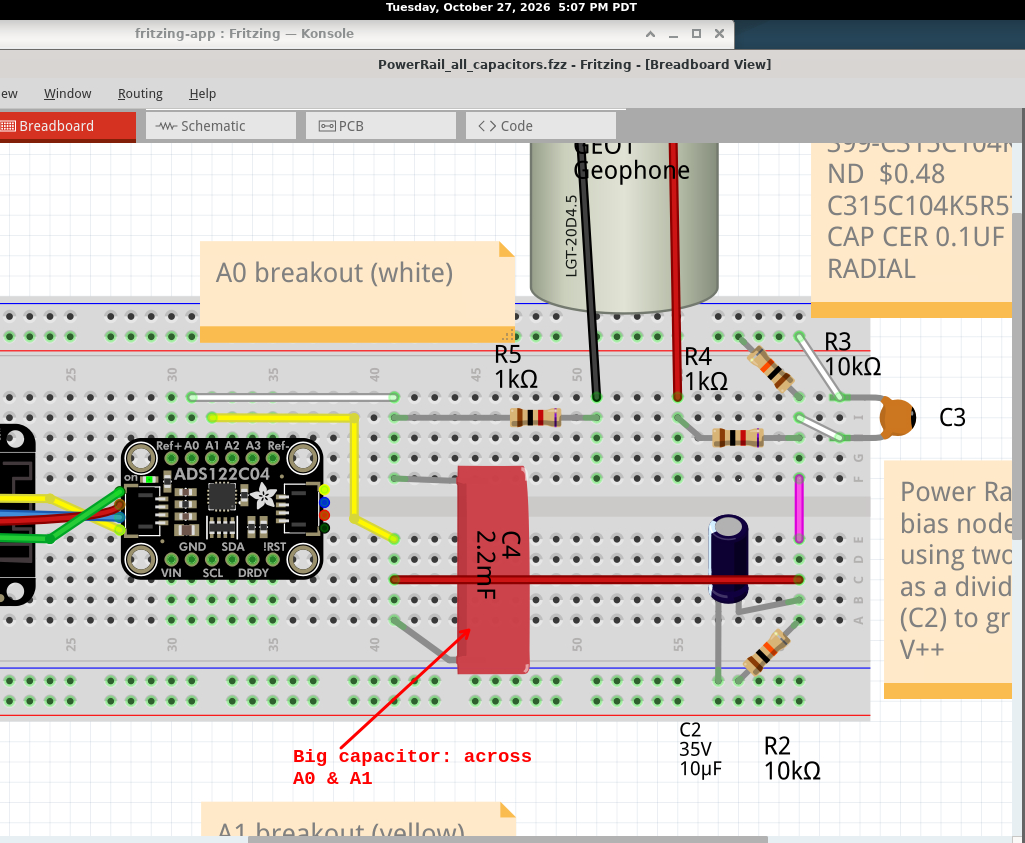
I’ve installed several artificial intelligence (“AI”) models on my own computers; I’m exploring the quality of responses from local AI and comparing the results. This test is simply this a screenshot and a prompt. This is the screenshot:
This is the prompt:
What can you tell me about this screenshot? what is in it and what does it accomplish?
The screenshot is from a program called Fritzing which let’s you model a breadboard circuit in a diagram. The circuit depicted here is a power rail that takes the small positive and negative values from the geophone and bumps them up to the median voltage of the Analog to Digital circuit’s (“ADC”) voltage boundaries: 0 – 3.2V. Raising the geophone’s voltages by 1.6V allows the ADC to see the negative voltages; otherwise values below 0 would not be within the ADC’s specifications and the results would not be reliable.
I tried with two local models which I refer to as Qwen and DeepSeek.
| Model | Parameter Size | File Size | Result | |
|---|---|---|---|---|
| qwen3.8-flash-next-iq3_s | ~180 billion | 87 GB | Described & analyzed | |
| deepseek-v4.1-flash | ~749 billion | 257 GB | Described only | |
| ChatGPT GPT-6 Astra Medium | unkown | web service | Described & analyzed: best analysis | |
Here is the Qwen response with some follow-up questions & answers.
Here is the DeepSeek response. I was disappointed with the result and decided not to ask further questions.
Here is the ChatGPT response. This provided a higher level analysis and correctly concludes it is an electronic seismometer.
Conclusion
I prefer the Qwen response, it actually analyzed the circuit and rendered an opinion, whereas the DeepSeek simply described what it saw.
Leave a Reply