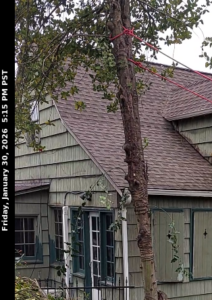
These were the last two of about 9 trunks of holly that were 20-25 tall at Peck Cottage next door. These two were especially difficult because they were leaning towards our house and the iron fence and Internet lifeline were in its path were it to fall into our house. I used ground anchors with rope and an come-along to ensure that the tree fell within Peck Cottage’s yard and not into our yard.
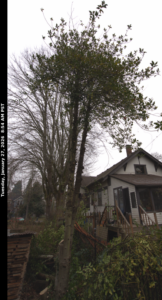
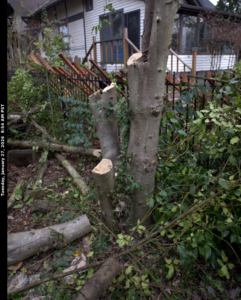
The largest trunk (both trunks combined) is about 9″ in diameter, so not a lot of lumber. Holly is very desirable because of its white color. It is a very hard wood exceeding our local bigleaf maples, but not as hard as sugar maples. Holly is harder than cherry, close to walnut, but moves more than both—making it ideal for small, refined objects rather than wide boards.
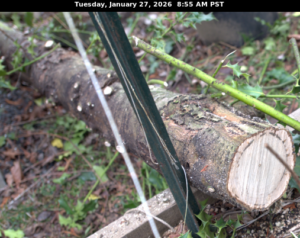
See the video (1’07”) at: https://salemdata.us/videos/20260130_142139.mp4 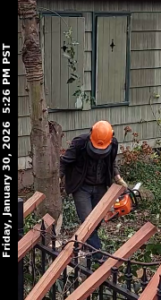
Comparative table — hardness & movement
| Wood species | Janka hardness (lbf) | Tangential shrinkage (%) | Radial shrinkage (%) | T/R ratio | Movement tendency | Notes |
|---|---|---|---|---|---|---|
| Holly (Ilex opaca) | ~1,020 | ~8.6 | ~4.8 | ~1.8 | Medium–High | Very fine grain, checks easily if rushed |
| Bigleaf (Broadleaf) maple (A. macrophyllum) | ~850 | ~7.4 | ~4.1 | ~1.8 | Medium | Softest maple; easy working |
| Sugar maple (A. saccharum / nigrum) | ~1,450 | ~9.9 | ~4.8 | ~2.1 | Medium–High | Hard, strong, but moves |
| Cherry (Prunus serotina) | ~950 | ~7.1 | ~3.7 | ~1.9 | Low–Medium | Very stable, forgiving |
| Black walnut (Juglans nigra) | ~1,010 | ~7.8 | ~5.5 | ~1.4 | Low | One of the most stable hardwoods |
| American elm (Ulmus americana) | ~830 | ~9.5 | ~4.2 | ~2.3 | High | Interlocked grain, resists splitting |
Source: ChatGPT


Leave a Reply to John Poole Cancel reply